
Looking credible matters.
Delivering on your promises, every time, is what builds trust.
A prospective client finds your business on LinkedIn. They visit your website, read a few reviews and eventually arrange a conversation. But the business they encounter at each stage looks different.
Your LinkedIn profile promises personal attention. Your website talks about processes and efficiency. Your sales conversation is dominated by a pitch rather than questions about their business.
Which version should they believe?
Buyers have more opportunities than ever to check what businesses say about themselves before making contact. Every interaction either reinforces their confidence or introduces doubt.
During September, business owners across the ONLE Network discussed what causes them to distrust another business or professional. Their answers highlighted something that businesses often overlook: honesty, reliability, listening and follow-through matter far more than polished presentation alone.
What business owners told us about distrust
In July 2026, Cassia Director Dean McKenna joined James West, Founder of the ONLE Network, to record an ONLE Talks podcast on trust in business relationships and the growing influence of digital communication. The episode was published at the start of September for the Network’s monthly meetings.
The conversation continued across ONLE’s networking meetings during September, where business owners and professionals were asked one question:
“What causes you to distrust a business or a business professional?”
Over 300 business owners and professionals attended ONLE meetings during the month. Their answers were recorded and grouped into 499 individual points of feedback across six themes.
The six themes, in order of how often they were raised, were:
- Honesty and integrity (25.9%): Dishonesty, misleading claims and a lack of transparency.
- Reliability and accountability (22.8%): Broken promises, poor follow-through and failure to take responsibility.
- Listening and communication (18.6%): Not listening, poor communication and a lack of respect.
- Sales pressure (15.2%): Aggressive selling, unwanted approaches and pushing for a sale too quickly.
- Authenticity (9.0%): Impersonal interactions, insincerity and obviously automated communication.
- Professional presence (8.4%): A lack of convincing evidence, professionalism or attention to detail.
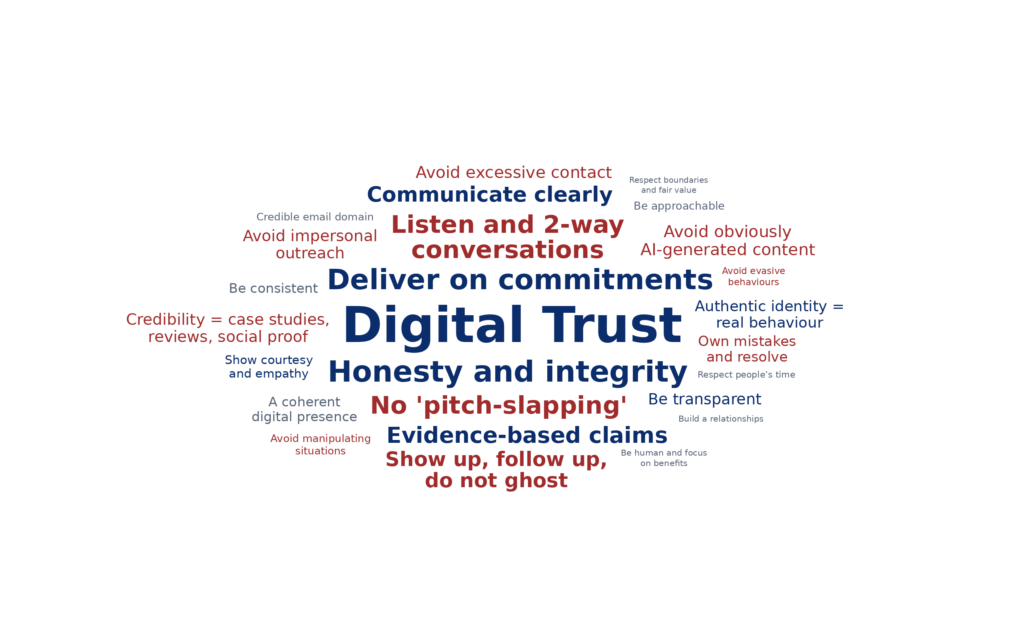
Honesty and reliability together accounted for almost half of all feedback, at 48.7%. The individual points raised most often were acting with honesty and integrity (52 times), keeping commitments and delivering what was agreed (50), listening and making the conversation two-way (41), and avoiding hard selling, overselling and ‘pitch-slapping’ (41).
Professional presence ranked last. People were not primarily concerned with how sophisticated a business’s marketing looked. They were describing behaviours that made them question whether someone was genuine, dependable and worth doing business with.
That is an important distinction for any business investing in its online credibility.
Credibility and trust are not the same thing
Credibility is what your business claims. Trust is what others believe after checking those claims.
Credentials, experience, testimonials and professional content help establish credibility. They give prospective clients, reasons to consider your business.
Trust develops when those claims are supported by evidence, consistent communication and behaviour.
Consider a consultant who promises measurable business improvements. Their website describes an impressive methodology and their LinkedIn profile highlights years of experience.
But there are no specific outcomes, client examples or explanations of how those improvements were achieved.
The consultant might be highly capable. The prospect simply lacks enough evidence to judge.
The same principle applies to behaviour. A business that promises responsiveness but repeatedly fails to follow up creates a contradiction between what it says and what it does.
During the ONLE Talks conversation, Dean discussed how buyers increasingly form opinions through multiple interactions before speaking directly to a business.
The sales conversation then becomes an opportunity to validate the trust that has already started to form, rather than needing to establish it from scratch.
We explore this distinction further in Credibility Is What You Claim. Trust Is What Others Believe.
Where the trust gap appears
Trust does not always disappear because of one poor interaction. Often, doubt develops through a series of small inconsistencies.
The ONLE discussions highlighted four areas where businesses unintentionally undermine the credibility they have worked hard to establish.
1. Claims without convincing proof
Businesses frequently describe themselves as trusted, experienced, client-focused or results-driven.
These claims are easy to make. They are harder for a prospective client to verify.
A firm’s website describes it as “trusted by leading businesses across the region”, with testimonials signed only with initials. Nothing on the page tells a prospect who those businesses are or what was achieved for them.
Making realistic, evidence-based claims came up 35 times in the ONLE discussions. Buyers notice when a claim has nothing behind it.
Without evidence, a claim is just another statement of expertise, and any competitor can make the same one.
2. Inconsistent identity and messaging
Your business should be recognisable across its different digital touchpoints.
That does not mean repeating identical content everywhere. It means maintaining a consistent account of who you help, what you do and why clients choose you.
Imagine a founder’s LinkedIn profile positioning the business as a specialist adviser to established companies, while its website still promotes general services to start-ups.
Both messages might reflect different stages in the firm’s history, but together they create confusion.
Communicating clearly, accurately and professionally was raised 32 times. When messages conflict, the prospect is left to decide which version is accurate.
3. Automation that pretends to be personal
AI and automation are valuable business tools. The problem arises when they replace genuine engagement while pretending to provide it.
Obviously AI-generated content was raised 22 times in the ONLE discussions, and impersonal outreach a further 20 times.
An automated LinkedIn message that immediately launches into a generic sales pitch is a familiar example.
The recipient quickly recognises that the apparent personal attention was not personal at all.
There is nothing wrong with automated newsletters, appointment reminders or routine administration. People understand their purpose.
But when a conversation begins personally, the next interaction should acknowledge that relationship.
The problem is not the technology. It is using it to manufacture the appearance of human communication.
4. Promises that are not followed through
A supplier agrees to send a proposal by Friday. Friday passes. No proposal arrives, and there is no explanation.
The prospect now has a practical reason to question the supplier’s reliability.
Showing up, following up and not disappearing from conversations came up 30 times, alongside the 50 mentions of keeping commitments.
Prospective clients use these early interactions to judge what working together will be like.
Missed deadlines, unanswered enquiries and forgotten commitments are trust signals too, online and off. They reveal how the business operates.
These behaviours are rarely difficult to improve. They require ownership, clear processes and consistent execution.
Six steps to identify and fix your trust gaps
The ONLE discussions highlight what causes doubt. The next step is to examine where your business might be creating it unintentionally.
This practical check can be completed over a week, without commissioning a major marketing review.
1. Identify your three strongest promises
What are the three things your business most wants to be known for?
Perhaps it is specialist expertise, personal attention, dependable delivery or measurable results.
Write down the claims exactly as they appear in your website content, LinkedIn profiles and proposals.
Avoid inventing new statements. The purpose is to examine what you are already telling prospective clients.
2. Attach evidence to each promise
For each claim, identify one piece of evidence a prospective client could verify.
That might be a named project example, a quantified outcome, a credible client review or a clear explanation of your methodology.
If you cannot support a claim, either find appropriate evidence or reconsider the wording.
The aim is not to make bigger promises. It is to make existing promises believable.
3. Check consistency across your main touchpoints
Put your three promises side by side as they appear on the company website, the founder’s LinkedIn profile and recent sales proposals.
Do they describe the same business?
Look for differences in positioning, target clients, service descriptions and claimed expertise.
Identify the most visible inconsistency and correct it.
For a website-specific review, see our companion article, What Your Website Is Really Saying About Your Business
4. Protect the personal moments
Review how your business follows up after a networking meeting, referral introduction or discovery conversation.
Does the first message acknowledge the discussion, or does it launch straight into a standard sales sequence?
A useful test is whether the message references something only the people involved in the conversation would know.
That small detail demonstrates listening and continuity.
Keep automation for activities where it adds efficiency without weakening the relationship.
5. Close the loop on commitments
Look at how enquiries, proposals, introductions and agreed actions are managed.
Are commitments recorded? Does someone own the next step? Is there a process for following up when circumstances change?
Choose one weak point and improve it.
Acknowledge delays, provide updates and close the loop even when the answer is no.
Reliability should be visible from the first interaction, not something clients discover only after appointing you.
6. Remove unnecessary sales pressure
Read your most recent outreach messages as though you were receiving them for the first time.
Are they relevant and useful? Do they show an understanding of the recipient’s circumstances?
Or are they simply pushing for a meeting?
Replace premature pitches with a thoughtful question, a relevant observation or an agreed next step.
Good business development creates opportunities for conversations. It does not need to force them.
Start with one improvement
By the end of this exercise, you should be able to identify three things:
- One important claim that lacks convincing proof.
- One touchpoint where your messaging is inconsistent.
- One follow-up habit that needs improving.
You do not need to fix everything at once.
Choose the gap most likely to undermine a prospective client’s confidence and address it first.
Trust is earned through consistent evidence and behaviour
The strongest message from the ONLE discussions is that business owners value more than professional presentation.
They want honesty, realistic claims, clear communication and evidence that commitments will be honoured.
For established businesses, these qualities should already be part of how they operate. The opportunity is to make them visible and consistent throughout the buyer journey.
Your digital presence should support the relationships you build, not create a different set of expectations.
When claims, evidence, communication and delivery agree, prospective clients have stronger reasons to believe what you say.
How credible is your business online?
Take Cassia’s free five-minute Online Credibility Diagnostic to see where your online presence is reinforcing credibility, where it may be creating doubt and what to improve next.
You will receive a short report with practical recommendations to help prioritise your next steps.
Frequently asked questions
What makes buyers distrust a business?
Dishonesty and unreliability are the biggest triggers. In ONLE Network discussions with over 300 business owners, honesty and reliability together accounted for almost half of all feedback, at 48.7%. Broken promises, poor listening, pushy selling and impersonal automated outreach followed. Polished presentation mattered least. Buyers judge a business on how it behaves, not just how it looks.
What is the difference between online credibility and trust?
Online credibility comes from the claims and evidence a business presents, including its expertise, credentials and client outcomes. Trust develops when people find that the business’s communication and behaviour consistently support those claims.
How can a business build trust with prospective clients online?
Start by making realistic, evidence-based claims. Keep messaging consistent across digital channels, respond to enquiries, honour commitments and use personal communication where relationships matter. These are all digital trust signals, and trust grows when they reinforce one another.
About the ONLE Talks findings:
The themes and figures in this article are drawn from open discussions held across ONLE Network business meetings in September 2026, attended by over 300 business owners and professionals.
Responses were recorded during the meetings and grouped into 499 individual points of feedback across six themes. Percentages are based on those 499 points, not on the number of attendees, and are rounded. They represent indicative qualitative feedback, not a statistically representative survey.